Blog
ADHD Chore Chart: The Ultimate Guide to Getting Things Done
What You’ll Learn in This Guide
By the end of this ultimate guide, you will:
- Understand why traditional chore charts fail for ADHD brains—and what to do instead
- Master 5 proven ADHD-friendly chore chart types with step-by-step setup instructions
- Create a customized system that works for children, teenagers, or adults
- Download free templates and checklists ready to use today
- Build sustainable habits without guilt, overwhelm, or burnout
Who This Guide Is For:
- Parents of children with ADHD
- Adults managing ADHD symptoms
- Partners living with someone who has ADHD
- Anyone seeking a more flexible approach to household task management
Estimated Reading Time: 25-30 minutes
Table of Contents (8 Chapters)
- ADHD and Chores: Why Is It So Hard?
- Preparation: What You Need Before Starting
- How the ADHD Brain Manages Tasks
- Step-by-Step: Creating an Effective ADHD Chore Chart
- 5 ADHD-Friendly Chore Chart Types Explained
- Advanced Strategies: When Basic Methods Aren’t Enough
- Real Cases and Community Insights
- Tools, Resources, and FAQs
Chapter 1: ADHD and Chores: Why Is It So Hard?
What Is an ADHD Chore Chart?
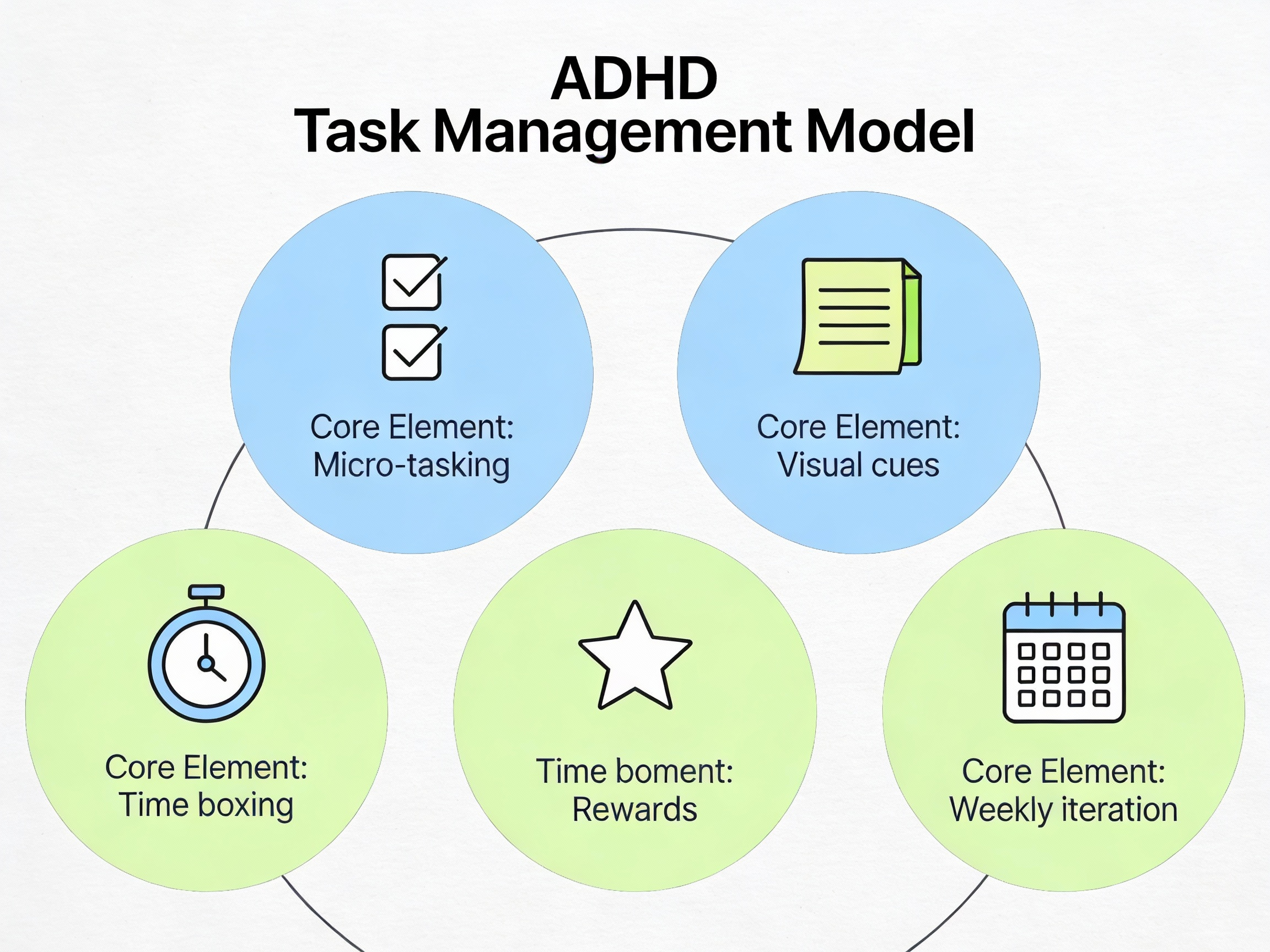
An ADHD chore chart is a visual task management tool specifically designed for how ADHD brains work. Unlike standard to-do lists or chore schedules, ADHD chore charts emphasize:
- Visual clarity over text-heavy instructions
- Flexibility over rigid schedules
- Immediate feedback over delayed gratification
- Micro-tasks over overwhelming mega-chores
The difference matters. A regular chore chart assumes you can simply “remember to do it” and “stay motivated.” An ADHD chore chart acknowledges that executive function challenges require a different approach entirely.
Why Traditional Chore Charts Fail for ADHD
Here’s the uncomfortable truth: traditional chore charts often make things worse for people with ADHD.
The Chore Chart Trap:
You create a beautiful, detailed chart. It feels satisfying to list every task. But then reality hits—you miss a day, tasks pile up, and suddenly the chart becomes a scoreboard of failure. Instead of helping, it triggers shame and avoidance.
Why this happens:
- Rigid structure clashes with ADHD’s need for flexibility. Life doesn’t follow a script, and neither does the ADHD brain.
- No immediate reward. ADHD brains are dopamine-seeking. Checking a box next Tuesday doesn’t provide the instant hit needed for motivation.
- All-or-nothing thinking. Miss one task? The whole system feels broken.
Common Misconceptions
Misconception #1: “If they have a list, they’ll do it.”
Lists don’t solve executive function challenges. The issue isn’t knowing what to do—it’s starting, sustaining, and completing the task.
Misconception #2: “They’re just lazy or undisciplined.”
ADHD is a neurological condition affecting the brain’s dopamine and executive function systems. Willpower alone cannot overcome brain chemistry.
Misconception #3: “More detailed rules = better results.”
Overly complex systems create cognitive overload. Simplicity wins every time.
Your Learning Path in This Guide
We’ll move through four phases:
- Understand the ADHD brain’s relationship with tasks
- Select the right chore chart type for your situation
- Create your personalized system step-by-step
- Iterate and scale with advanced strategies
Let’s begin.
Chapter 2: Preparation: What You Need Before Starting
Before creating your ADHD chore chart, gather the right tools and set realistic expectations.
Tools and Materials
Choose what works best for you—you don’t need everything on this list. Pick one or two items from either category to get started.
Physical Tools (choose any):
- Whiteboard or magnetic board – Easy to update, satisfying to erase
- Colorful markers and magnets – Visual variety keeps engagement high
- Sticky notes – Perfect for flexible task movement
- Stickers – Especially effective for children’s reward systems
- Visual timer – Creates urgency without stress
Digital Tools (choose any):
- Task management tools –
TadaFlow, habit trackers, reminder apps - Phone notifications – Set on home screen for visibility
- Digital timers – Color-changing timers work well for time boxing
Assess Your Needs First
Ask yourself:
| Question | Options |
|---|---|
| Who is this for? | Child / Teen / Adult / Family |
| What’s the goal? | Daily maintenance / Deep cleaning / Family collaboration |
| What’s your energy pattern? | Morning person / Night owl / Unpredictable |
| Physical or digital preference? | Paper / App / Hybrid |
Set Realistic Expectations
Start small. Begin with 3-5 core tasks maximum. You can always add more later.
Perfection is the enemy. A “good enough” system you actually use beats a perfect system you abandon.
Build in reset space. Plans will derail. That’s not failure—it’s normal. Your system needs a way to recover.
Environment Setup
Placement matters. Put your chore chart where you’ll see it constantly:
- Refrigerator door
- Entryway or mudroom
- Bathroom mirror
- Phone home screen (for digital)
Reduce friction. Keep markers, stickers, and magnets within arm’s reach of the chart. Every extra step is a barrier.
Chapter 3: How the ADHD Brain Manages Tasks
Understanding why ADHD makes chores difficult is the key to building systems that actually work.
Executive Function and Household Tasks
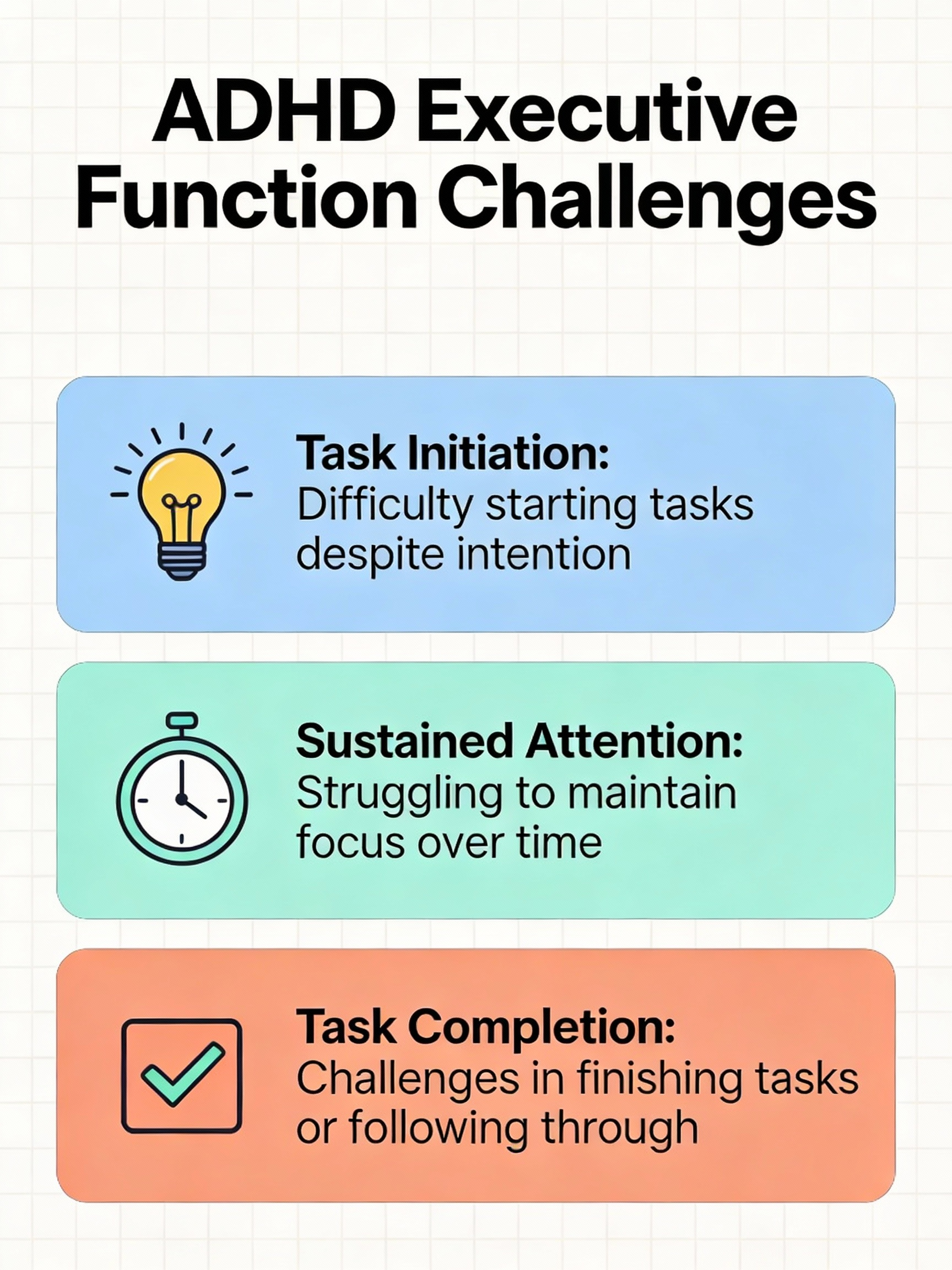
Executive function is your brain’s “management system.” It handles planning, prioritizing, starting tasks, and seeing them through. ADHD affects executive function in three critical ways:
1. Working Memory Challenges
”I walked into the kitchen to… wait, why am I here?”
Working memory holds information temporarily while you use it. With ADHD, this buffer is smaller and clears faster. You forget tasks seconds after thinking of them.
2. Time Blindness
”I thought that would take 5 minutes. It’s been an hour.”
ADHD brains struggle to accurately perceive and estimate time. This leads to chronic underestimation of how long tasks take—and chronic lateness or incomplete work.
3. Task Initiation Difficulty
”I know I need to do it. I just… can’t start.”
The hardest part of any chore isn’t doing it—it’s beginning. ADHD creates a gap between intention and action that willpower alone cannot bridge.
The Dopamine Factor
ADHD brains have different dopamine regulation. Dopamine is the “reward chemical” that motivates action. Here’s the problem:
- Neurotypical brains can generate motivation from future rewards (“I’ll feel good when the house is clean”)
- ADHD brains need immediate, tangible rewards to activate motivation
This is why “you should do it because it’s important” rarely works. The ADHD brain needs now rewards, not later rewards.
The Science Behind Visual Cues
Research consistently shows that visual aids improve task completion for people with ADHD. Why?
- Out of sight = out of mind. If you can’t see it, it doesn’t exist to your brain.
- Visual cues bypass working memory. The chart remembers so you don’t have to.
- Color and images engage attention. ADHD brains are drawn to novelty and visual stimulation.
The Structure vs. Flexibility Balance
ADHD needs structure—but not rigidity. The solution is flexible structure:
- Structure provides the framework (what needs to be done)
- Flexibility allows choice within that framework (when and how)
Think of it as a “priority pool” rather than a strict schedule. You have 3 tasks to complete today. Do them in whatever order feels right. Switch if energy dips. The goal is completion, not compliance.
Chapter 4: Step-by-Step: Creating an Effective ADHD Chore Chart
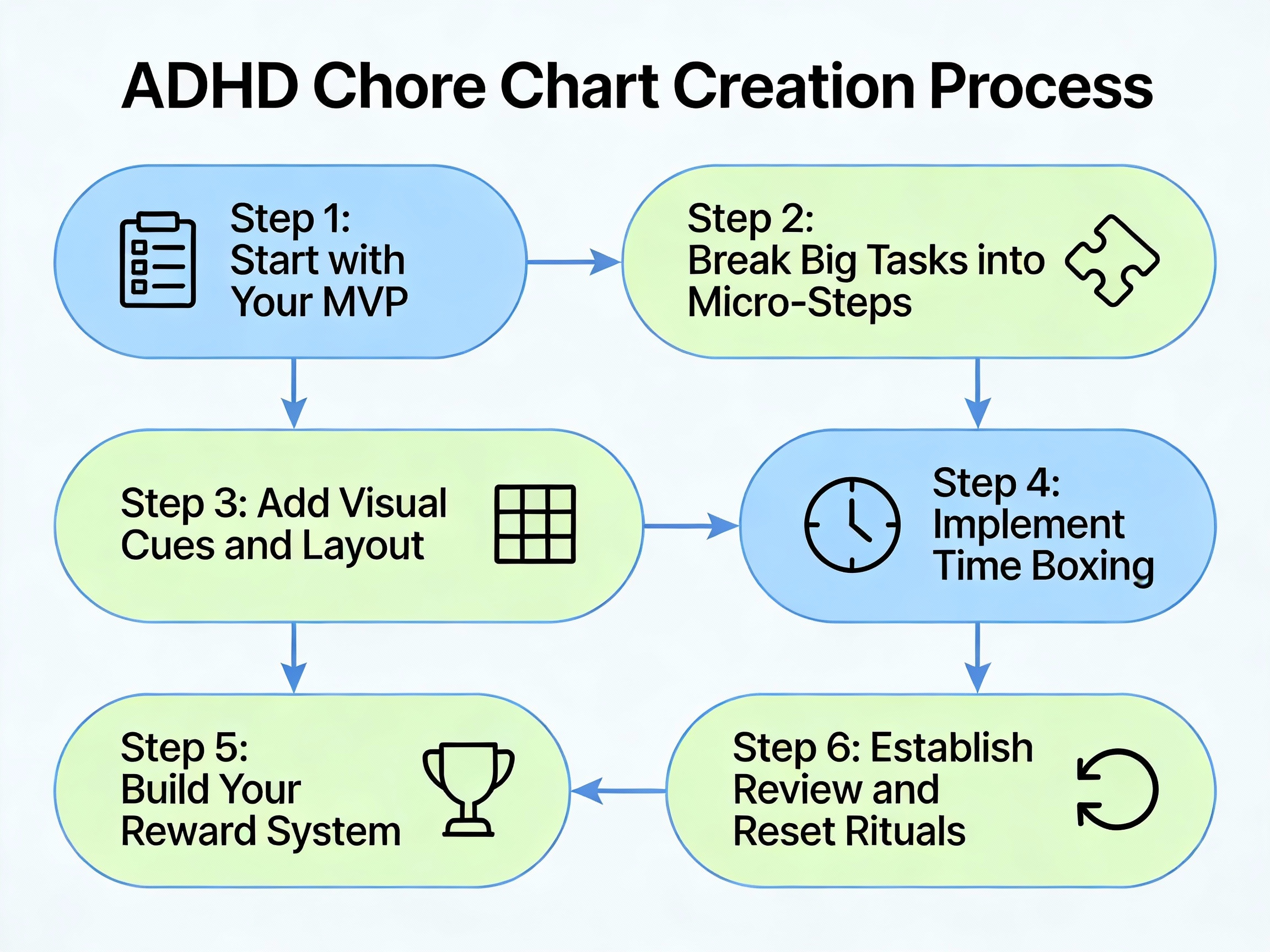
Now let’s build your ADHD chore chart from scratch. Follow these six steps.
Step 1: Start with Your MVP (Minimum Viable Chores)
Don’t list everything. Start with only 3-5 essential tasks.
How to choose:
- What causes the most stress when undone?
- What has the biggest impact on daily life?
- What’s realistic given your current capacity?
Example starter list:
- Wash dishes
- Clear kitchen counter
- Take out trash
- Put dirty clothes in hamper
- Wipe bathroom sink
Common Mistake: Loading 20 tasks onto the chart immediately. This guarantees overwhelm and abandonment.
Pro Tip: Ask yourself, “What’s the absolute minimum to keep things functional?” Start there.
Step 2: Break Big Tasks into Micro-Steps
ADHD brains freeze when facing large, vague tasks. The solution: micro-tasking.
Instead of: “Clean the kitchen”
Write:
- Clear the counter
- Put dishes in sink
- Wipe one section of counter
- Take out trash
Each micro-step should take 2-10 minutes maximum. If it takes longer, break it down further.
Example: Bathroom Cleaning Breakdown
| Vague Task | Micro-Steps |
|---|---|
| Clean bathroom | Wipe sink, Wipe mirror, Scrub toilet bowl, Empty trash, Replace towels |
Common Mistake: Breaking tasks into too many tiny pieces, creating management overhead.
Pro Tip: Use the format: Verb + Object + Location (“Wipe counter in kitchen”)
Step 3: Add Visual Cues and Layout
Make your chart visually engaging and easy to scan.
Color coding options:
- By room (kitchen = blue, bathroom = green)
- By urgency (red = must do, yellow = should do, green = nice to do)
- By person (if family chart)
For children: Use pictures or icons instead of text. A toothbrush icon for “brush teeth,” a bed icon for “make bed.”
Layout structure:
Create three columns: To Do → In Progress → Done
Moving tasks physically from left to right provides visual satisfaction and dopamine hits.
Common Mistake: Cramming too much information into small spaces with tiny fonts.
Pro Tip: Change colors or themes weekly to maintain novelty and prevent boredom.
Step 4: Implement Time Boxing
Time boxing means setting a timer and working until it ends—regardless of whether you finish.
How it works:
- Choose a task
- Set timer for 10, 15, or 20 minutes
- Work until the timer ends
- Stop without guilt, even if unfinished
Why this works for ADHD:
- Creates artificial urgency (dopamine!)
- Removes the pressure of “finishing”
- Makes starting less intimidating (“It’s only 15 minutes”)
Common Mistake: Treating time boxes as deadlines to complete tasks, which recreates pressure.
Pro Tip: Use visual timers that change color as time runs out. The visual countdown adds urgency without stress.
Step 5: Build Your Reward System
ADHD brains need external motivation. Design rewards that are:
- Immediate – Delivered right after task completion
- Tangible – Something you can see, feel, or experience
- Sustainable – Rewards you can actually provide consistently
Reward system options:
Point System:
- Each task = points
- Points accumulate toward rewards
- Example: 10 points = 30 minutes of screen time
Sticker Chart (for kids):
- Complete task = add sticker
- Full row = small reward
- Full chart = big reward
Reward Banking:
- Complete several tasks = “bank” toward a larger reward
- Example: 5 completed days = movie night
Common Mistake: Inconsistent reward delivery, which breaks trust in the system.
Pro Tip: Rotate rewards regularly to maintain interest. What’s exciting today becomes boring next month.
Step 6: Establish Review and Reset Rituals
No system survives contact with real life without adjustment.
Daily Review (2-3 minutes):
- What got done?
- What didn’t? Why?
- What’s the priority for tomorrow?
Weekly Review (10 minutes):
- What’s working?
- What’s causing friction?
- What needs to change?
The Reset Strategy:
When everything falls apart (and it will), don’t abandon the system. Use this reset protocol:
- Pause. Breathe.
- Pick ONE easy task
- Complete it
- Let that small win rebuild momentum
Common Mistake: Expecting perfect execution and treating any deviation as failure.
Pro Tip: Build “reset days” into your system. One day per week where the only goal is one simple task.
Chapter 5: 5 ADHD-Friendly Chore Chart Types Explained
Not all chore charts work for all people. Here are five proven types—choose the one that fits your situation.
Type 1: The Classic Visual Chore Chart
Best for: Children, visual learners, those who prefer physical tools
What it is: A whiteboard or poster with tasks listed, checkboxes or sticker spots, and bright colors.
How to use it:
- List daily tasks with icons or pictures
- Use stickers or checkmarks for completion
- Erase and reset daily or weekly
- Change themes/colors regularly to prevent boredom
Pros: Tangible, satisfying, no technology required
Cons: Requires manual updating, can get cluttered
Type 2: The Digital Chore Chart
Best for: Teens, adults, tech-comfortable users, those with unpredictable schedules
What it is: A digital system with reminders, flexible scheduling, and progress tracking.
Recommended tool: TadaFlow offers ADHD-friendly features specifically designed for neurodivergent minds. It transforms overwhelming housework into simple, actionable cleaning routines with built-in flexibility.
How to use it:
- Set up tasks as short, clear steps (“Wipe counters” not “Clean kitchen”)
- Enable notifications on your home screen
- Use the built-in flexibility to adjust tasks on difficult days
Pros: Always with you, automatic reminders, easy to adjust
Cons: Requires phone access, potential for notification fatigue
Type 3: The Reward-Based Chart
Best for: Anyone who needs external motivation, children, adults who struggle with intrinsic motivation
What it is: A system where every task earns points toward rewards.
How to use it:
- Assign point values to tasks (harder tasks = more points)
- Set reward thresholds (10 points = coffee break, 50 points = movie night)
- Track points visually
- Rotate rewards to maintain interest
Pros: Direct motivation link, gamifies boring tasks
Cons: Requires consistent reward delivery, may need frequent reward updates
Type 4: The “Done” List
Best for: People who feel defeated by uncompleted to-do lists, those prone to negative self-talk
What it is: Instead of tracking what needs to be done, you track what you’ve already completed.
How to use it:
- Start with a blank list each day
- Write down each task AS you complete it
- Review at day’s end to see accomplishments
- Celebrate the wins, no matter how small
Why it works: Shifts focus from failure (what’s left) to success (what’s done). Each entry provides a dopamine hit.
Pros: Builds confidence, eliminates shame spiral
Cons: Doesn’t provide task reminders, works best combined with another system
Type 5: The Chore Draft / Rotation Chart
Best for: Families, couples, roommates, anyone sharing household responsibilities
What it is: A collaborative system where household members take turns choosing tasks.
How to use it:
- List all weekly chores
- Take turns “drafting” tasks you don’t hate
- Each person is responsible for their chosen tasks
- Complete by end of week (flexible timing)
- Rotate draft order weekly
Why it works: Gives autonomy and choice. People are more likely to complete tasks they selected themselves.
Pros: Fair distribution, reduces resentment, builds teamwork
Cons: Requires buy-in from all participants
Chapter 6: Advanced Strategies: When Basic Methods Aren’t Enough
Sometimes the basics aren’t enough. Here are advanced techniques for stubborn situations.
Strategy 1: The Priority Pool
Instead of scheduling specific tasks at specific times, create a daily “pool” of 1-3 priorities.
How it works:
- Each morning, identify 1-3 tasks that matter most
- Complete them in any order
- If energy drops, switch to the easiest one
- Anything beyond the pool is bonus
Why it works: Provides structure without rigidity. You have direction but also choice.
Strategy 2: Body Doubling
Body doubling means having another person present while you work—not helping, just existing nearby.
Why it works: The presence of another person activates social accountability circuits in the brain, making task initiation easier.
How to implement:
- Work alongside a family member doing their own tasks
- Video call a friend while you both clean
- Use “body doubling” apps or virtual coworking sessions
Strategy 3: Energy-Based Task Matching
Match task difficulty to your current energy level.
| Energy Level | Task Type |
|---|---|
| High | Deep cleaning, organizing, multi-step tasks |
| Medium | Regular maintenance, dishes, laundry |
| Low | Trash, wiping surfaces, putting one thing away |
Pro Tip: Create a pre-sorted list of tasks by energy requirement. When energy is low, you don’t have to think—just pick from the “low energy” column.
Strategy 4: Habit Stacking
Attach new habits to existing routines.
Formula: “After I [existing habit], I will [new task].”
Examples:
- “After I pour my morning coffee, I will wipe the kitchen counter.”
- “After I brush my teeth, I will put dirty clothes in the hamper.”
- “After I eat dinner, I will load the dishwasher.”
Scaling to Family Systems
Once your personal system works, expand it:
- Start with yourself. Model the system before involving others.
- Introduce gradually. Add one family member at a time.
- Allow customization. Each person may need different chart types.
- Hold weekly family meetings. Review what’s working, adjust what isn’t.
Chapter 7: Community Insights
Real Discussions from the ADHD Community
The ADHD community has developed practical solutions through lived experience. Here’s a real discussion from partners navigating chore distribution together:
What's the structure of your to-do/chore chart with you partner?
byu/Monk-in-Black inADHD_partners
Key takeaways from this discussion:
- Whiteboard in high-traffic areas works better than apps for some couples
- The “Chore Draft” method (taking turns picking tasks) reduces conflict
- Flexibility on timing (complete by weekend, not by specific day) accommodates ADHD variability
- Both partners need to invest in the system for it to work
Chapter 8: Tools, Resources, and FAQs
Recommended Tools
| Category | Tool | Best For |
|---|---|---|
| Digital Tool | TadaFlow | ADHD-specific cleaning planner with flexible routines |
| Visual Timer | Time Timer | Color-changing countdown for time boxing |
| Physical Board | Magnetic task board | Satisfying task movement, no tech needed |
| Habit Tracker | Simple habit apps | Daily streak motivation |
Downloadable Resources
ADHD Cleaning Checklist by Room:
This checklist breaks cleaning tasks into specific, actionable steps organized by home area—perfect for reducing overwhelm:
Areas covered:
- Kitchen/Dining: Wipe counters, clean cabinets, scrub sink, deep clean appliances
- Living Room: Dust surfaces, clean floors, wipe light fixtures, organize cushions
- Bathroom: Clean toilet, shower, sink, mirrors, replace towels
- Bedroom: Dust, make bed, clean floors
- Laundry Area: Clean washer/dryer, organize supplies
Children’s Chore Chart Template:
A colorful, structured chart designed to help kids build consistent chore habits:
Features:
- Daily Chores section: Blank lines for tasks with weekday checkboxes
- Weekly Chores section: Color-coded by day of week
- Notes area: For instructions or tracking
Frequently Asked Questions
1. Why can’t I finish chores even with a chore chart?
Your chart may be too rigid. ADHD brains need flexibility. Try breaking tasks into smaller steps, using time boxing instead of task completion goals, or switching to a “Done List” approach.
2. My child lost interest in the chore chart. What now?
Refresh the system: change colors, update rewards, or involve your child in redesigning it. Novelty matters for ADHD brains. Also ensure rewards are being delivered consistently.
3. Do adults really need chore charts?
Yes. ADHD doesn’t disappear with age. Adults benefit equally from visual systems, external structure, and reward mechanisms. The format may differ (apps vs. stickers), but the principles remain.
4. Digital or paper—which is better?
It depends on your preference. Some people need the tactile satisfaction of physical charts. Others need the portability and reminders of digital tools. Many find a hybrid approach works best.
5. How detailed should tasks be?
Detailed enough to be clear, but not so detailed that managing the list becomes a chore itself. Each task should represent 2-10 minutes of work and one clear action.
6. Won’t rewards make my child only work for rewards?
Research shows positive reinforcement is more effective than punishment for behavior change. Over time, habits form and external rewards can be gradually reduced. The goal is building the habit first.
7. My partner won’t participate. What do I do?
Start with low-pressure approaches like the “Chore Draft” method, which gives autonomy rather than assigning tasks. Focus on systems rather than blame. If resistance continues, consider whether this is a relationship issue beyond chore distribution.
8. How often should I update the chore chart?
Review weekly, adjust monthly. Systems need regular maintenance. What works in January may not work in June.
9. How do I handle “all-or-nothing” thinking?
Use the “Done List” approach to focus on what you accomplished rather than what you didn’t. Celebrate partial completion. One task done is infinitely better than zero tasks done.
10. What’s the best ADHD-friendly cleaning app?
TadaFlow is specifically designed for neurodivergent minds. It transforms overwhelming housework into simple, actionable cleaning routines with the flexibility ADHD brains need. Visit TadaFlow.com to try it.
Conclusion
Key Takeaways
-
ADHD brains need flexibility + visual cues + immediate rewards. Traditional rigid chore charts fail because they ignore how ADHD actually works.
-
Micro-tasking is the core technique. Break every large task into 2-10 minute steps. “Clean the kitchen” becomes “wipe counter,” “load dishwasher,” “take out trash.”
-
Choose the right chart type for your situation. Visual charts for kids, digital apps for adults, rotation systems for families. There’s no one-size-fits-all.
-
Perfection is the enemy. Build reset mechanisms into your system. Plans will fail. That’s not failure—that’s data for improvement.
-
Small wins compound. Every completed task builds momentum. Focus on progress, not perfection.
Your First Step: Start Today
Don’t wait for the perfect system. Start now with this simple action:
- Choose 3 tasks that matter most today
- Write them on sticky notes
- Put them somewhere visible (refrigerator, bathroom mirror, desk)
- Complete one. Remove the note. Feel that small dopamine hit.
That’s it. You’ve started.
Ready for a Complete Solution?
If you want an ADHD-friendly system that’s already built for neurodivergent brains, try TadaFlow—the ADHD Cleaning Planner that transforms chaos into clarity.
TadaFlow offers:
- Simple, actionable cleaning routines
- Flexibility for unpredictable days
- Structure without rigidity
- Designed specifically for ADHD minds
Managing chores with ADHD isn’t about perfection—it’s about finding systems that work with your brain, not against it. Small wins add up. Every step forward is a success.